Links
Kusadasi Guide
Kusadasi Tours
Cheap Holidays to Kusadasi
|
 |
The Ancient Ephesus Ruins and History
|
 |
|
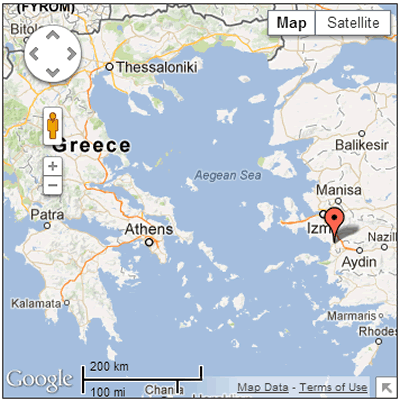
Ephesus, once the most important
commercial center of the western Anatolia, is one of the highlights of
Turkey that awaits the exploring tourists.
The city was established as a port on the mouth of the river Cayster and
was one of the foremost cities of the world for its being on a strategic
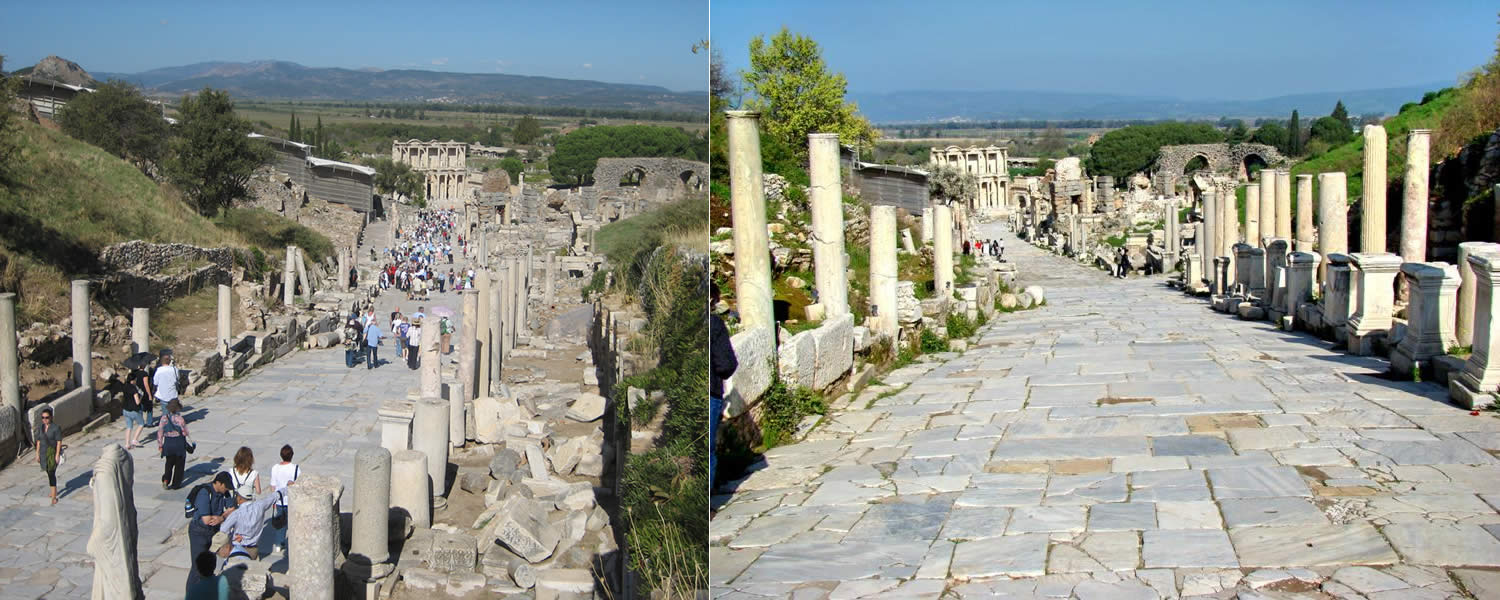
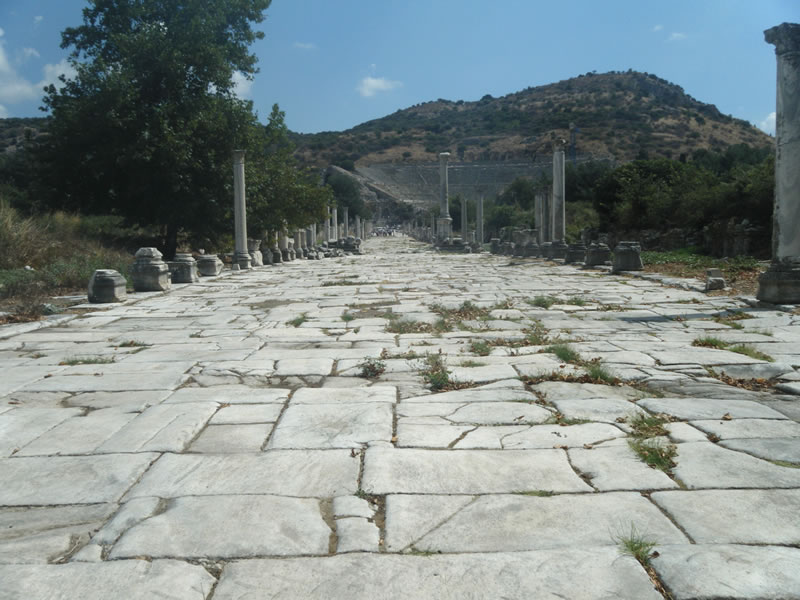
trade route in Anatolia. The city itself and the ruins are all on the
sides of a fertile valley.The extensive ruins including the theatre,
library or gymnasium create the special atmosphere of Ephesus, and appeal
to every visitors. |
|
|
Ephesus has been a "center" during the date. Once a trade center of the
ancient world, a religious center of the early Christianity and today, a
unique tourism center proving all its perfectas to the visitors through
the world.
History:
There is as yet no definite
knowledge about the exact date of the foundation of Ephesus, but famous
historians such as Strabon and Pausanias, agreed in the idea of that
Ephesus was founded by Amazons, and inhabited by the oldest settlers of
Anatolia-Lelegians and Carians, as early as 3000 BC. In the year of 10 BC,
Androclos, the son of King of Athens-Kodros, was searching a location for
establishing a site. Androclos belonged to Akhas ,was running from the Dor
invasion in Greece. He was leading one of the migration convoys. It was
predicted by an Apollon oracle that a fish and a boar would show the
location of the new settlement. |
|
| Days
later, parallel to the oracle’s prediction, while frying, a fish fell down
from the pan, irritating a hiding boar behind the bushes. The feared boar
escaped immediately. Androclos followed the boar and established the city
of Ephesus, where he had killed the boar. When Androclos died in the wars
with Carians, a mausoleum was built to the memory of the first king of
Ephesus. The mausoleum is considered to be placed around "The Door of
Magnesia". |
|
 |
|
|
Ephesus was ruled by the Lydian king, Kreisos, in the mid 6BC. The city
reached the "Golden Age" and became a good model to the Antic World in
culture and art, as well. But the inhabitants of Ephesus moved away.
Because they did not like being ruled and lived in the new Ephesus that is
located around the area of Temple of Artemis. As the detailed excavations
have not completed yet, apart from the Artemision, the remains of that age
haven’t been revealed. |
|
 |
|
Later, Ephesus was dominated by Persians. As Ephesians did not join the
"Ionian Rebellion" against Persians, the city was saved from destruction.
The rebellion resulted in the loss of Persian. Alexander the Great won
Persians and the Ionian cities got their independence in the year of 334.
Ephesus was in great prosperity during the times of Alexander the Great
Until the arrival of Alexander the Great, Ephesus was consisted of two
governing systems, democratic and oligarchic. But the oligarchic system
was violated with the coming of a new ruler, and a rebellion existed in
Ephesus. The Temple of Artemision was fired and destroyed by the
supporters of oligarchy in 356BC. |
|
As the temple became unusable, Alexander the Great proposed for repairing.
But the Ephesians
delicately refused for the reason that "A God can not built a temple for a
God." An Ephesian architect, Dinocrates restored the Temple of Artemision.
After the death of Alexander the Great, Ephesus was ruled by the general
of him, Lysimakhos, 287 BC. |
| |
|
|
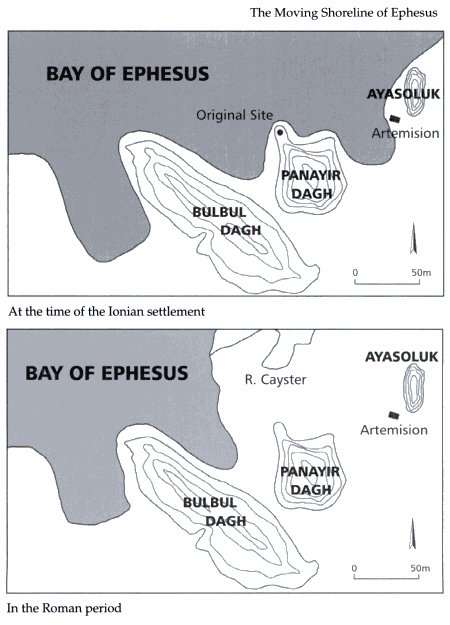
Lysimakhos decided to change the prior location of Ephesus to further
west, due to the destruction of the port by the alluviums, and the
inhabitants were forced to settle in the new place named "Arsinoeina", the
name of Lysimakhos’ wife. The city was surrounded by wide stone walls in
10 meters height and 9 meters length. With the death of Lysimakhos,
Ephesians destroyed most of the city walls. And, "Arsinoeina" was changed
into "Ephesus" again, to be forgotten eternally. |
|
 |
|
|
Ephesus was controlled by the Romans in 190 BC. The city was given to the Bergamian kings for a time. With the death of King
Attalos 3 in 133BC, the city was re-ruled by the Romans. Ephesus reached
to its height and was notorious for its wealth and luxury between 1-4 AD.,
especially during the reign of Augustus. During the period, the population
of Ephesus increased to 225 000, and the city became the capital of the
new Asia. By cleaning the river Caystros from the alluviums, the great
trade port of Ephesus, a gateway to foreign countries, enriched the
prosperity of the city and continued to thrive with commerce and culture.
The city was constructed, adding new models to the former magnificence of
Ephesus. "Celcius Library" clearly exemplifies the perfecta of the era,
with the delicate details of the construction. |
|
 |
|
Ephesus has played significant roles during the date, in the early
Christianity, as well. The prestige of Ephesus increased with the arrival
of Saint Paul, for spreading the Christianity to the Ephesians
worshipping to Artemision. St. Paul and the disciplines of Christianity
were strictly refused by Ephesians, elderly. With the long tiring
struggles of St. Paul, Christianity was accepted by the most of the
population around Ephesus. St. Paul had also sent one of his most famous
letters to the church in Ephesus. Additionally,
St. Jean and
Virgin Mary visited Ephesus and Virgin
Mary settled down the Mount Bulbul, located close to Ephesus, around the
years of 431 AD.
|
|
Ephesus became a state of Seljukian in the year of 1090, for a time was
held by Byzantine. In 1307 Seljukians controlled the city again. But, years
later, the River Caystros was silted up, leaving the site far inland. |
|
|
|
Therefore, the city of Ephesus has lost its significance, due to the
development of the ports of Izmir and Kusadasi in sea trade. Alexander the
Great won Persians and the Ionian cities got their independence in the
year of 334. Ephesus was in great prosperity during the times of Alexander
the Great Until the arrival of Alexander the Great, Ephesus was consisted
of two governing systems, democratic and oligarchic. But the oligarchic
system was violated with the coming of a new ruler, and a rebellion
existed in Ephesus. The Temple of Artemision was fired and destroyed by
the supporters of oligarchy in 356BC. As the temple became unusable,
Alexander the Great proposed for |
|
 |
|
repairing. But the Ephesians delicately refused for the reason that "A God
can not built a temple for a God." An Ephesian architect, Dinocrates
restored the Temple of Artemision. After the
death of Alexander the Great, Ephesus was ruled by the general of him,
Lysimakhos, in 287 BC. |
| |
|
 |
|
Lysimakhos decided to change the prior location of Ephesus to further
west, due to the destruction of the port by the alluviums, and the
inhabitants were forced to settle in the new place named "Arsinoeina", the
name of Lysimakhos’ wife. The city was surrounded by wide stone walls in
10 meters height and 9 meters length. With the death of Lysimakhos,
Ephesians destroyed most of the city walls. And, "Arsinoeina" was changed
into "Ephesus" again. Ephesus was controlled by the Romans in 190 BC. The
city was given to the Bergamian kings for a time. With the death of King
Attalos 3 in 133BC, the city was re-ruled by the Romans. Ephesus reached
to its height and was notorious for its |
|
wealth and luxury between 1-4 AD , especially during the reign of
Augustus. During the
period, the population of Ephesus increased to 225 000, and the city
became the capital of the new Asia. |
| |
|
| By
cleaning the river Caystros from the alluviums, the great trade port of
Ephesus, a gateway to foreign countries, enriched the prosperity of the
city and continued to thrive with commerce and culture. The city was
constructed, adding new models to the former magnificence of Ephesus.
"Celcius Library" clearly exemplifies the perfecta of the era, with the
delicate details of the construction.Ephesus has played significant roles
during the date, in the early Christianity, as well. The prestige of
Ephesus increased with the arrival of Saint Paul, for spreading the
Christianity to the Ephesians worshipping to Artemision. St. Paul and the
disciplines of Christianity were strictly refused by Ephesians, elderly. |
|
 |
|
|
|
 |
|
With the
long tiring struggles of St. Paul, Christianity was accepted by the most
of the population around Ephesus. St. Paul had also sent one of his most
famous letters to the church in Ephesus. Additionally, St Jean and Virgin
Mary visited Ephesus and Virgin Mary settled down the Mount Bulbul,
located close to Ephesus, around the years of 431 AD. Ephesus became a
state of Seljukian in the year of 1090, for a time was held by Byzantine.
In 1307 Seljukians controlled the city again.However, years later, the
River Caystros was silted up, leaving the site far inland. Therefore, the
city of Ephesus has lost its significance, due to the development of the
ports of Izmir and Kusadasi in |
|
sea-trade. |
| |
|
|